
Sandbender
Audio Damage, Inc.
No ratings yetMusicAges 4+
Screenshots



About this app
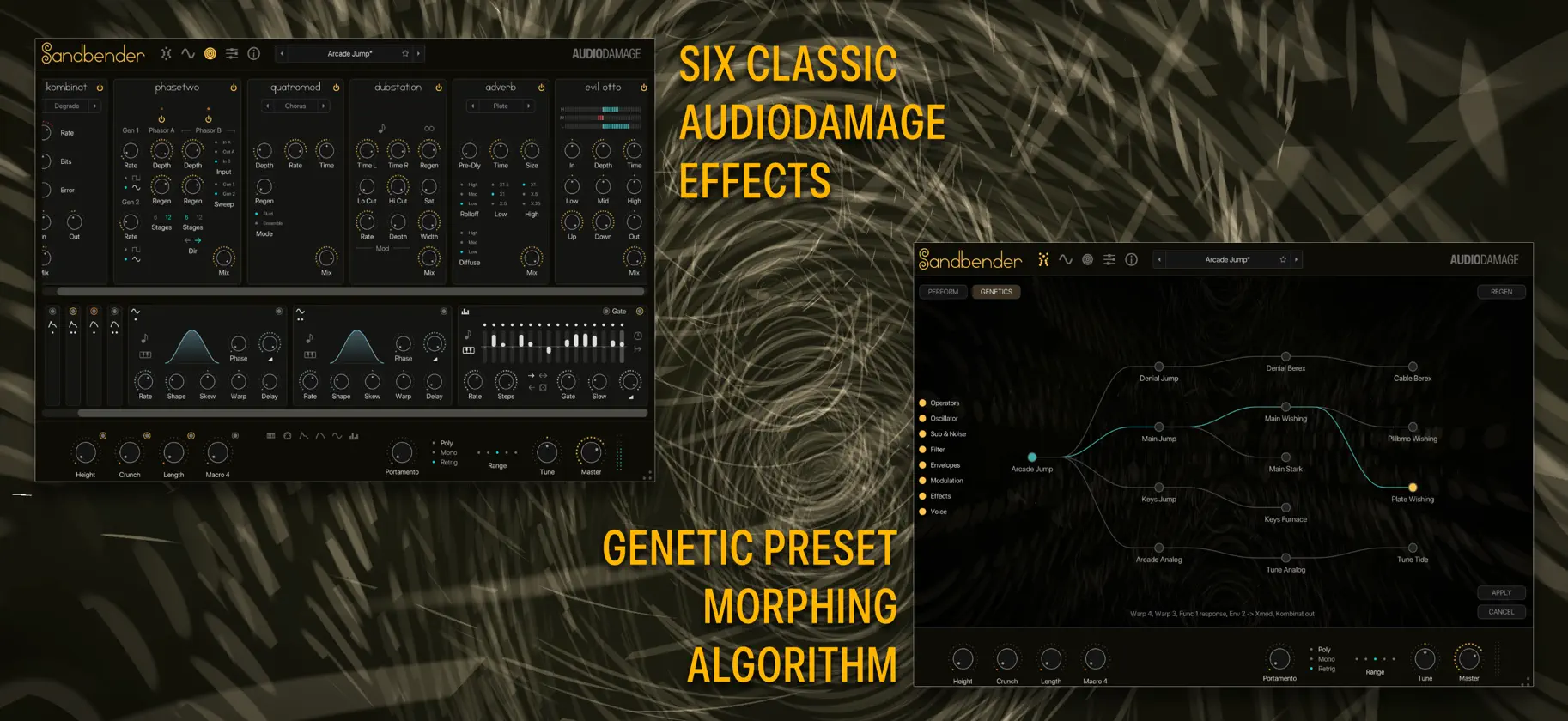
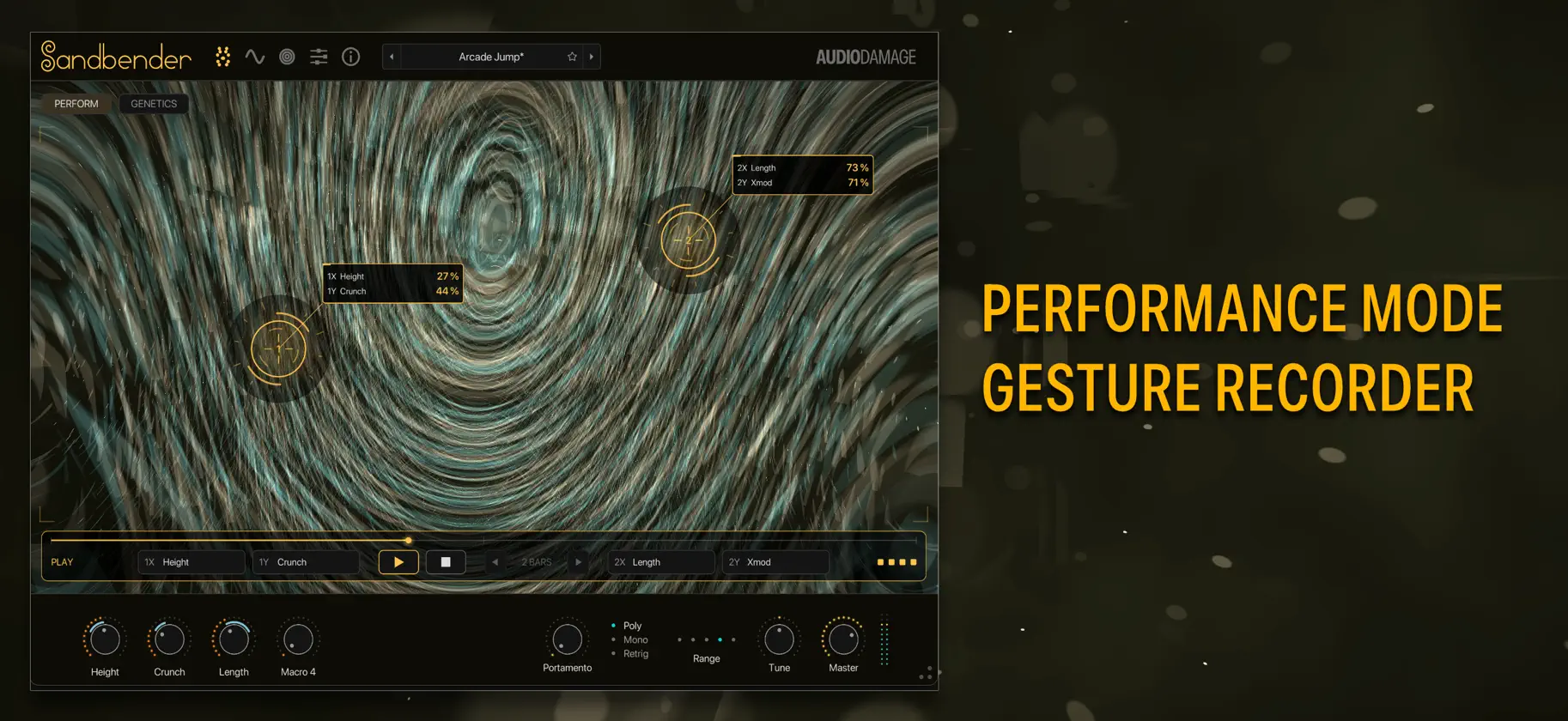
FM synthesis has always had a bit of an image problem. Everybody loves the sound, but nobody wants to program it, which is why most of the FM you've heard in your life was a factory preset that nobody dared to touch. (Touching it was a fast way to turn an electric piano in to a fax machine.) With Sandbender, the four operators are where a sound starts. They're all here, in ten factory algorithms or any routing you feel like drawing, but every operator has a wave shaper of its own, there's a wavefolder, a sub oscillator, and six flavors of noise alongside them, and the whole lot runs through a proper filter and a low pass gate. If all you want is a nice FM bell, I'm happy to report that Sandbender makes a very nice FM bell. It just seems a shame to stop there. We also tried to make the programming part less of a chore, since that was the whole problem in the first place. Modulation is drag-and-drop: grab a source off the rail (envelopes, LFOs, a couple of function generators, a step sequencer, the macros, and all the MIDI and MPE stuff) and drop it on pretty much any knob. And if you'd rather not program at all, nobody's going to blame you. The GENETICS page breeds new patches out of whatever you're playing, and PERFORM gives you two nodes to shove around the screen, plus a gesture recorder for when you stumble on something good. Six of our effects sit at the end of the chain, in whatever order you like, and there are 260-odd presets in the box to get you going. On iPhone and iPad, Sandbender is an AUv3 for whatever host you like, and a standalone app for when you'd rather skip the host. FEATURES • Four-operator FM: ten factory algorithms plus an algorithm designer for drawing your own. Each operator tunes by harmonic ratio, free ratio, or fixed frequency. • Warp and Fold: a one-knob shaper on every operator morphs its wave from triangle through sine to pulse, and the wavefolder adds harmonics without rearranging the sidebands. • Sub oscillator and noise: a divider sub clocked by operator 1, and six noise types, each with Color and stereo Width. • Eleven filter types: state-variable, ladder, diode, and Sallen-Key designs in low pass, high pass, and band pass, running in stereo in every voice. • Low pass gate: each voice ends in a plain VCA or a modeled low pass gate, for the pluck and the woody decay. • Envelopes and LFOs: two ADSR envelopes per voice with curve controls, and two LFOs, free or synced to host tempo. • Function generators: two per voice. They rise and fall on a trigger, cycle as LFOs, or slew any source routed into them. • Step sequencer: sixteen steps, each a value and a gate, with four directions, slew, and an internal clock, host sync, or a clock from any modulation source. It runs in every voice. • Drag-and-drop modulation: drag a source onto a knob, set a bipolar depth, and watch the knob move with it. • Four macros: renameable knobs on the strip under every page, ready to drive anything in the patch and to automate from the host. • GENETICS: choose which parts of the patch may change, and Sandbender grows a family tree of variants from the current sound. Tap a node to hear it, double-tap it to breed from there. • PERFORM: two nodes on a full-page touch surface, played with two fingers, and a tempo-synced gesture loop of 1 to 8 bars that saves with the preset. • Six classic Audio Damage effects, in any order: Evil Otto multiband compression, Dubstation delay, ADverb reverb, Quatromod's flanger, chorus, diffusor, and frequency shifter, Kombinat's thirteen distortions, and the Phasetwo dual phaser. • MPE and microtuning: full MPE, with per-note pitch bend, pressure, and slide on CC 74, and microtuning from .tun files. • Eight voices: poly, mono, or retriggered mono, with portamento, an output limiter, and 1x to 8x oversampling. • Over 260 factory presets in nine categories, in a browser with a 3D tag cloud that finds presets by tag and by author.


