
Screenshots




About this app
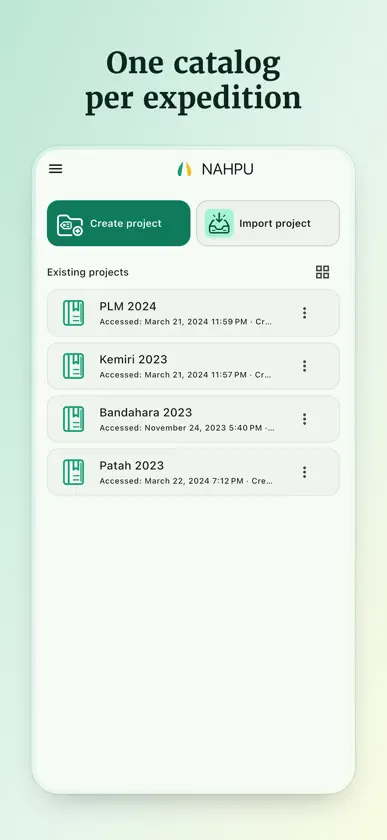
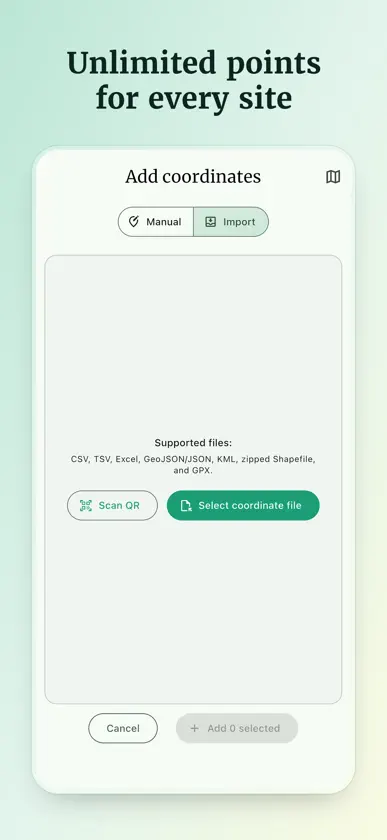
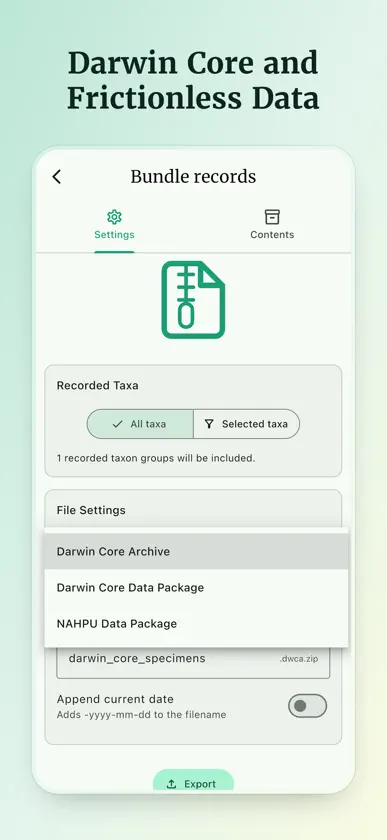
NAHPU is a free, open-source digital field catalog for natural history research. It helps field researchers, museum staff, students, and collection teams keep specimens, sites, collection events, tissues, media, and notes connected within a single project. Built for real field conditions, NAHPU’s core cataloging workflow works offline and requires no account. Your records remain on your device unless you choose to export, back up, or share them. What you can do - Organize projects, team members, and taxon registries - Catalog mammals, birds, herpetofauna, and arthropods with group-specific fields - Record sites, coordinates, habitats, collecting events, effort, and environmental context - Track specimens, preparations, parts, tissue samples, measurements, and associated data - Capture and organize photos, audio, video, and field notes - Exchange selected records and settings with QR codes - Review collection statistics during fieldwork - Export records as CSV, TSV, Excel, or JSON - Create Darwin Core Archives, Darwin Core Data Packages, and NAHPU Data Packages - Transfer projects, create restorable backups, and design PDF labels and documents From field capture to curation NAHPU keeps related records together and reduces repeated entry across field and museum workflows. Its open-standard exports, including Darwin Core, help teams move structured records into analysis, collection-management, and biodiversity publishing systems. Private by design NAHPU does not require an account. Core data is stored on your device, and you decide when to export or share it. Some optional map views require an internet connection. Responsible use NAHPU is a cataloging tool. You are responsible for following applicable permits, institutional protocols, ethical standards, and local laws when collecting or handling specimens. Note that the records shown in app screenshots are for illustrative purposes only and do not reflect real field data.
What's new
Version 1.3.0 · Nov 9, 2026
Parasites are now symbionts, so NAHPU can record any organism living on or in a host. New • Interaction types: parasitic, parasitoid, mutualistic, commensal, phoretic, or unknown. Each has its own icon and helper text, and exports as Darwin Core organismInteractionType. • New symbionts start with the host's collection date. • Resize data table columns by dragging a header edge; double-click to reset. Hover a cut-off cell to see its full value. • Search fields in the data table column picker. Improved • Categories (ectosymbiont, endosymbiont, mesosymbiont) describe where a symbiont lives and apply to parasitic and parasitoid interactions. • The collector network is now called the graph. • On iPhone, the data table keeps one toolbar row and opens filters in sheets. • Specimen part and symbiont forms use the extra space on iPad and Mac. • Existing projects, transfers, presets, and templates still import. Fixed • PDF documents not rendering with newer Typst versions. Notes: Symbiont values are controlled vocabulary that are user-customizable.
More from Heru Handika


You might also like
 GBIF NearbyMarkus Doring
 Catalogue of LifeMarkus Doring
 SICB 2024 Annual MeetingSociety for Integrative & Comparative Biology
 DeepTime for GeologyHunt Mountain Software
 ResearchPod: Paper PodcastsNOAH PAUL MAGEL
 YaleUConnectNovalsys, Inc
 GATOR SAFEUniversity of Florida
 RockdUniversity of Wisconsin-Madison Shared Apps
 Transact eAccountsILLUMIA, LLC
 Explorer - AMNH NYCAmerican Museum of Natural History