
Plasmid editor
young-Hwan Jo
No ratings yetEducationAges 4+
Screenshots



About this app
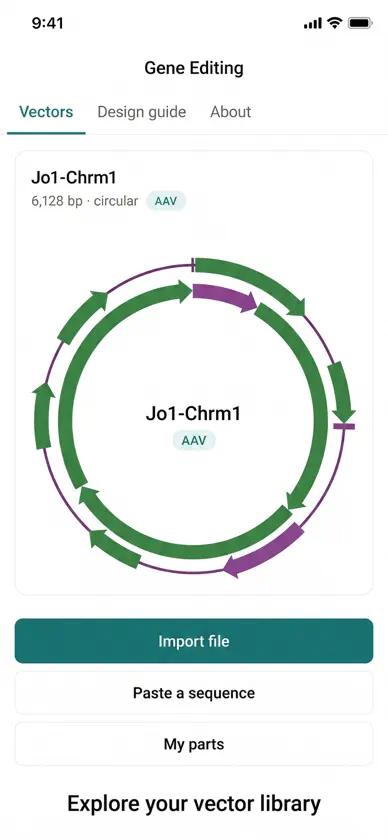
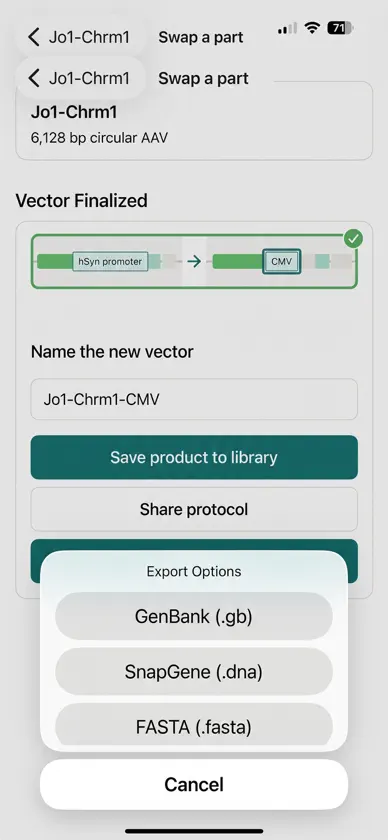
Import a SnapGene, GenBank or FASTA file. Every element is matched against the bases rather than trusted from the label, and each one is marked with how it was established: confirmed by exact sequence match, taken from the file's own annotation, or predicted from structure alone. 1. FOUR EDITS Replace the promoter. Add a gene. Remove a gene. Swap a part. Each one produces a finished construct, the Gibson assembly plan, and primers with melting temperatures. Homology arms extend until they are unique, so repeated sequence does not produce an ambiguous junction. Every design is re-assembled in silico before it is issued: if the product does not come back identical, you do not get the plan. 2. DESIGNS THAT WOULD HAVE FAILED QUIETLY A cargo in a FLEX or DIO cassette is stored antisense. Paste a normally written coding sequence into those coordinates and it goes in backwards. The app works out the required orientation from the cassette architecture and places it correctly. An annotated CDS is often only part of a longer reading frame. Replace just the annotated piece and your new gene inherits whatever sat in front of it — tags, targeting motifs, linkers - as an N-terminal fusion. The app reads upstream in frame, names what it finds, and offers to remove it. 3. PACKAGING SIZE, BEFORE YOU ORDER The ITR-to-ITR genome is measured and compared against the real limit for AAV, self-complementary AAV, lentivirus or adenovirus. When a design is too large, you get specific reductions with the base pairs each one saves and what it costs you. 4. PROMOTERS AND CAPSIDS Sixteen promoters covering neurons, astrocytes, hepatocytes, cardiomyocytes and ubiquitous expression. Each was read out of a publicly deposited plasmid map and carries the Addgene number and the exact coordinates it came from. They are exactly what that deposit contains - not sequence written from memory. A capsid guide pairs cell types with AAV serotypes, each with the caveat that matters. 5. EXPORT GenBank, SnapGene, or FASTA. Annotations, strands and topology survive the first two; FASTA is bases only, and the app says so before you pick it. 6. PRIVATE BY CONSTRUCTION No account. No analytics. No advertising. Your vectors stay on your device. The app works offline; the one exception is an optional NCBI lookup when you type an accession, which sends nothing but that accession. 7. COMPANION APP Gene Search, free, finds genes and accessions in NCBI and hands them straight to this app. Gene Editing is a design aid. Every construct is a prediction from the sequence you supplied, and predictions can be wrong - most often because the file's own annotations were wrong. Verify every junction by sequencing before you rely on a construct.
More from young-Hwan Jo


You might also like
 PlasmidViewer ProMARTIN WILLIAMS
 ZiNote: Artículos Científicos小双 王
 NEB ToolsNew England Biolabs Inc
 TCG Stacked: Card UtilitiesMinner Labs LLC
 Neuroscience 2026Society for Neuroscience
 R Discovery: Academic ResearchCACTUS COMMUNICATIONS SERVICES PTE. LTD
 Outer space guide: UniverseEducation Terra
 Shinobi: Lee y Aprende JaponésJeremy Pitault
 Tabla Periódica - Química 2026Nikita Chernykh
 Vaia: Flashcards y estudio IAStudySmarter GmbH